Map Snapshot


1 Record
Citations
No citations linked for this taxon yet.
Source: Wikipedia
| Suillus cavipes | |
|---|---|

| |
Scientific classification 
| |
| Kingdom: | Fungi |
| Division: | Basidiomycota |
| Class: | Agaricomycetes |
| Order: | Boletales |
| Family: | Suillaceae |
| Genus: | Suillus |
| Species: | S. cavipes
|
| Binomial name | |
| Suillus cavipes | |
| Synonyms[1] | |
|
Boletus cavipes Opat. (1836) | |
| Suillus cavipes | |
|---|---|
| Mycological characteristics | |
 | Pores on hymenium |
 | Cap is convex |
 | Hymenium is adnate |
 | Stipe is bare |
 | Ecology is mycorrhizal |
 | Edibility is edible |
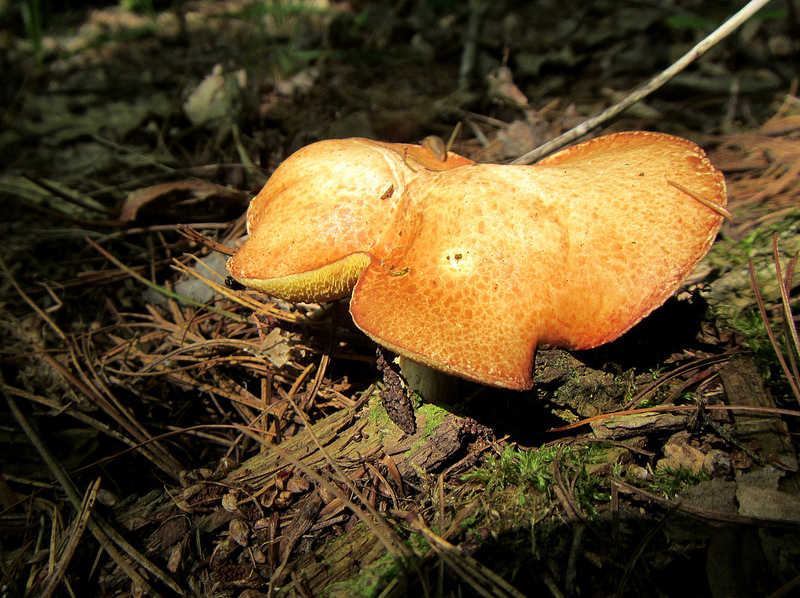
Suillus cavipes, commonly known as the hollow foot[2] is a species of mushroom in the genus Suillus.[3] The epithet cavipes (Latin: 'hollow foot') refers to the hollow stem.[4]
The brownish cap is up to 12 centimetres (4+3⁄4 in) wide, dry, fibrillose, sometimes with veil remnants on the edge.[2] The pores are buff and usually decurrent.[2] The stipe is up to 9 cm long and 2 cm thick, yellowish above, sometimes with a slight ring, and cap-colored below.[2] The flesh is whitish and firm.[2]
It is found in Europe and North America. It is associated with larch in the Pacific Northwest.[4] It is edible.[2]
See also
[edit]References
[edit]- ^ "Suillus cavipes (Opat.) A.H. Sm. & Thiers 1964". MycoBank. International Mycological Association. Retrieved 2011-01-05.
- ^ a b c d e f Arora, David (1986) [1979]. Mushrooms Demystified: A Comprehensive Guide to the Fleshy Fungi (2nd ed.). Berkeley, CA: Ten Speed Press. pp. 494–95. ISBN 978-0-89815-170-1.
- ^ Phillips, Roger (2010). Mushrooms and Other Fungi of North America. Buffalo, NY: Firefly Books. p. 287. ISBN 978-1-55407-651-2.
- ^ a b Trudell, Steve; Ammirati, Joe (2009). Mushrooms of the Pacific Northwest. Timber Press Field Guides. Portland, OR: Timber Press. p. 222. ISBN 978-0-88192-935-5.
External links
[edit] Media related to Suillus cavipes at Wikimedia Commons
- Suillus cavipes in Index Fungorum.

 | This Boletales-related article is a stub. You can help Wikipedia by adding missing information. |