
Map Snapshot


30 Records
Status
Description
Relationships
Citations
No citations linked for this taxon yet.
Source: Wikipedia
| Xeromphalina campanella | |
|---|---|

| |
Scientific classification 
| |
| Kingdom: | Fungi |
| Division: | Basidiomycota |
| Class: | Agaricomycetes |
| Order: | Agaricales |
| Family: | Mycenaceae |
| Genus: | Xeromphalina |
| Species: | X. campanella
|
| Binomial name | |
| Xeromphalina campanella | |
| Xeromphalina campanella | |
|---|---|
| Mycological characteristics | |
 | Gills on hymenium |

 | Cap is convex or depressed |
 | Hymenium is decurrent |
 | Stipe is bare |
 | Spore print is white |
 | Ecology is saprotrophic |

 | Edibility is unknown or inedible |
Xeromphalina campanella is a species of mushroom. Its common names include the golden trumpet and the bell Omphalina. It is a cold-tolerant species found throughout North America and Eurasia.
Taxonomy
[edit]The genus name Xeromphalina means "little dry navel" and campanella means "bell-shaped", respectively describing the mature and young shapes of the cap.[2] The mushroom is also called fuzzy-foot.[3]

Description
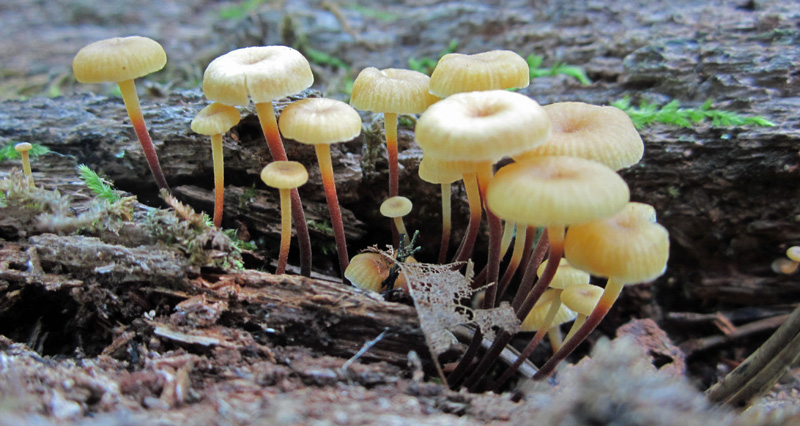
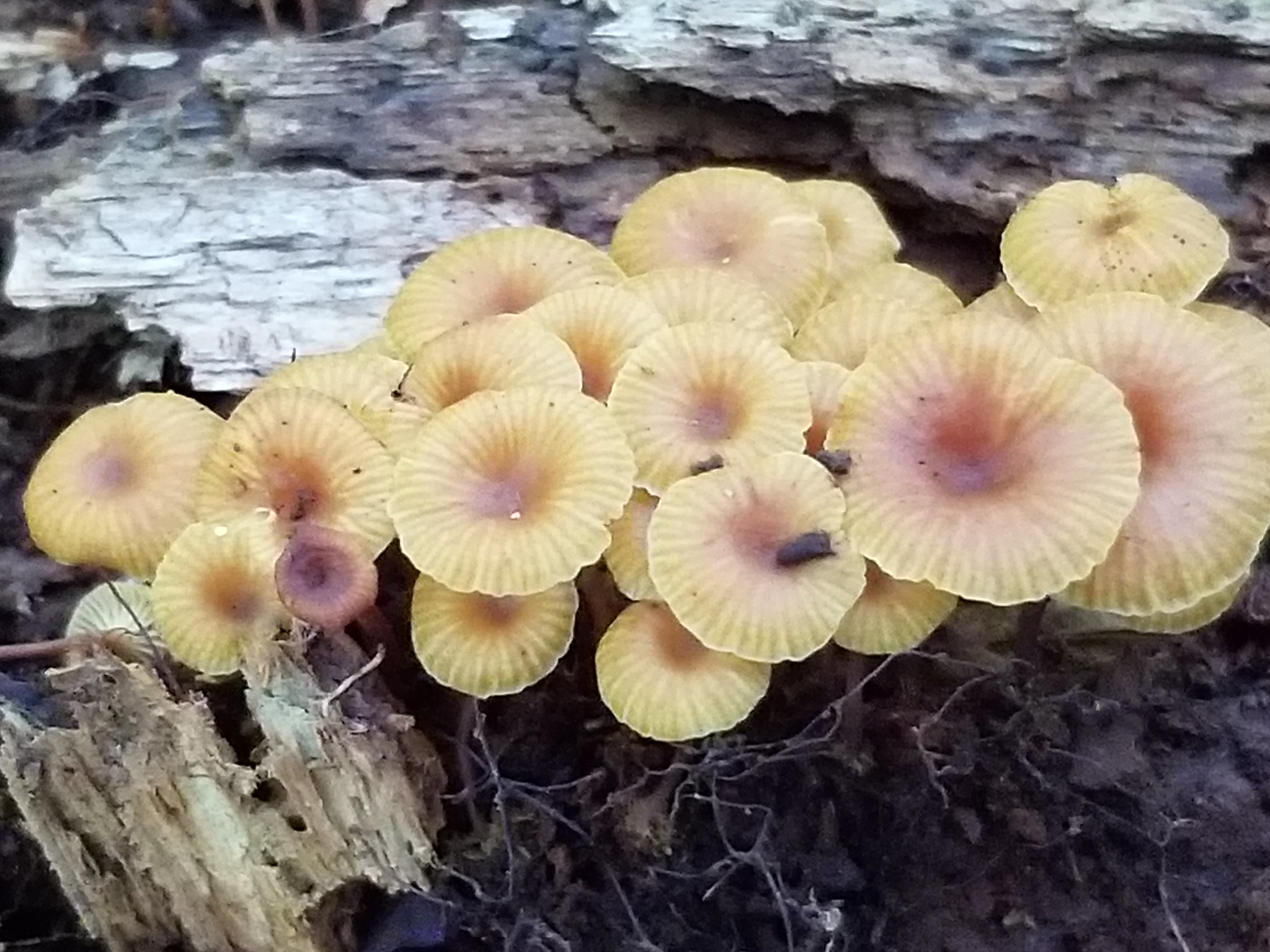
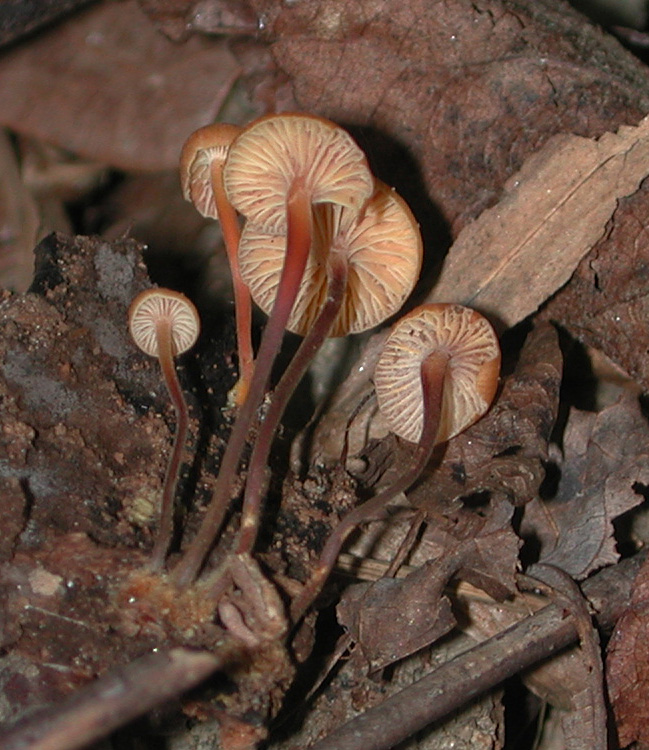
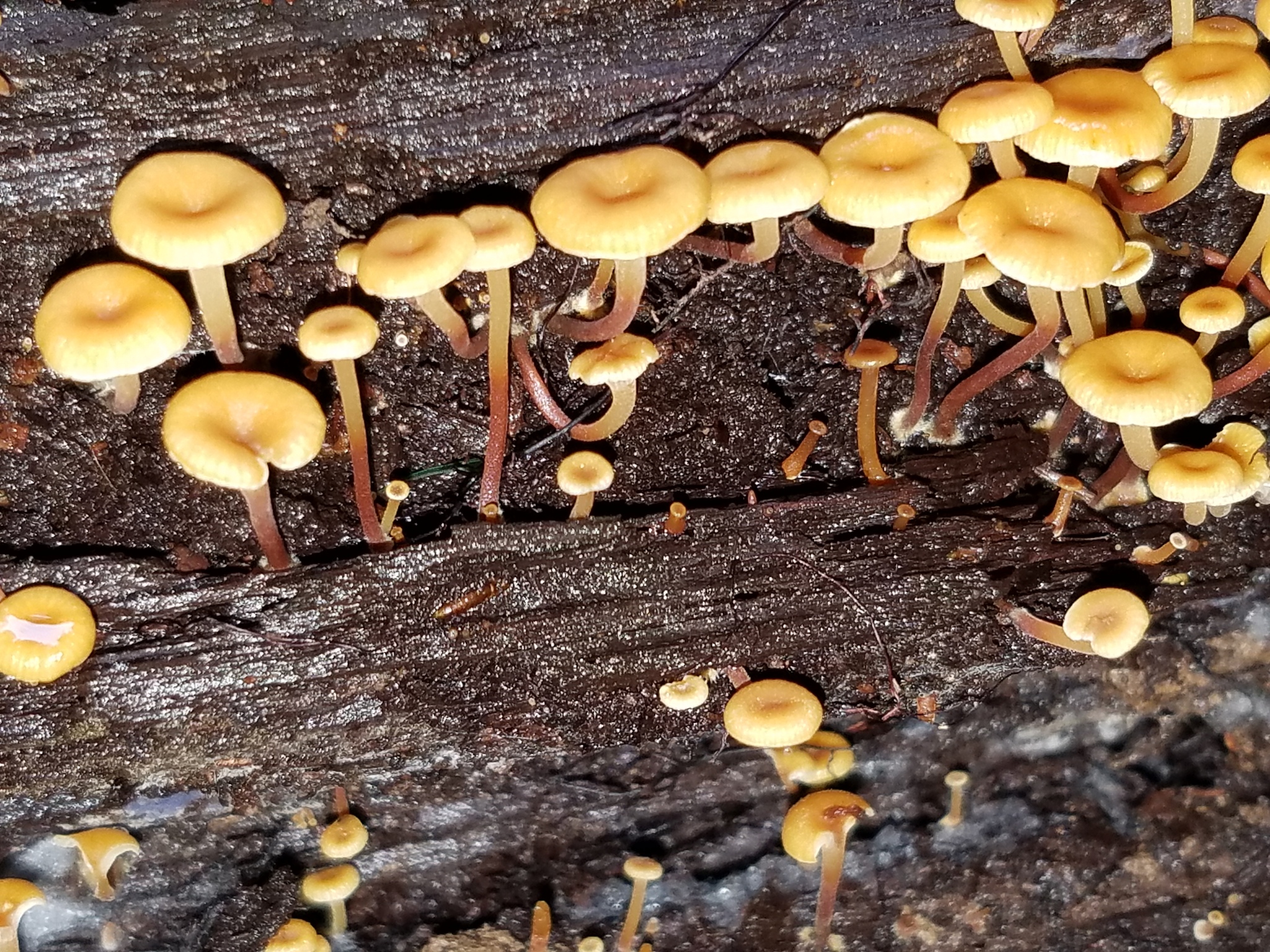
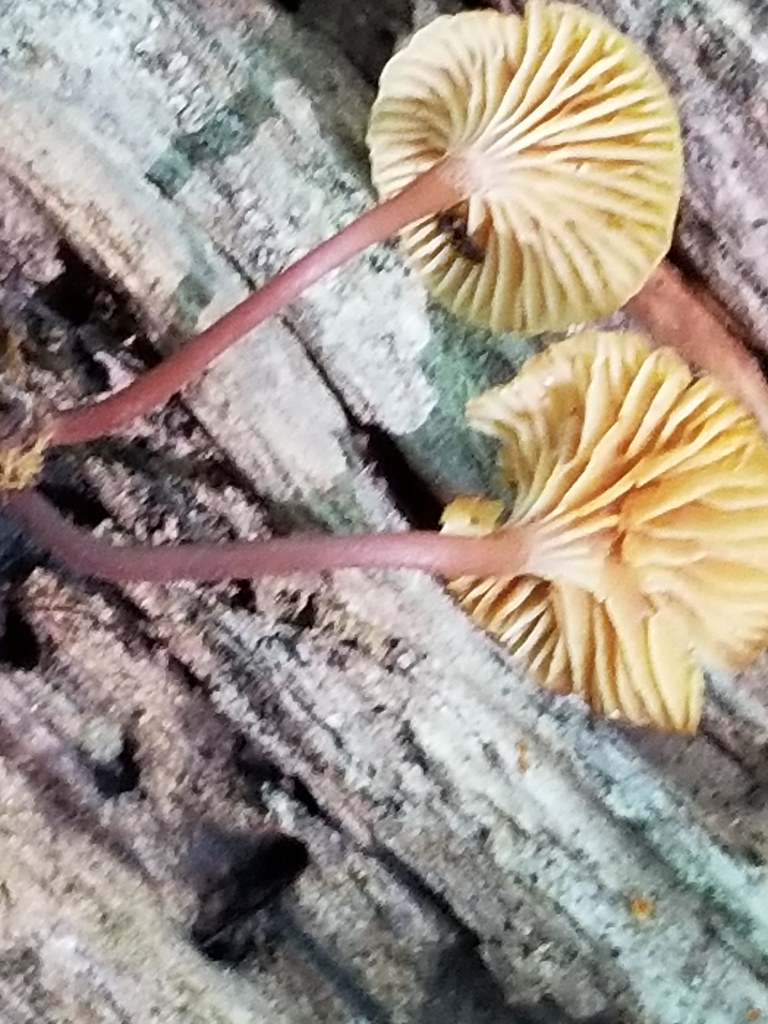
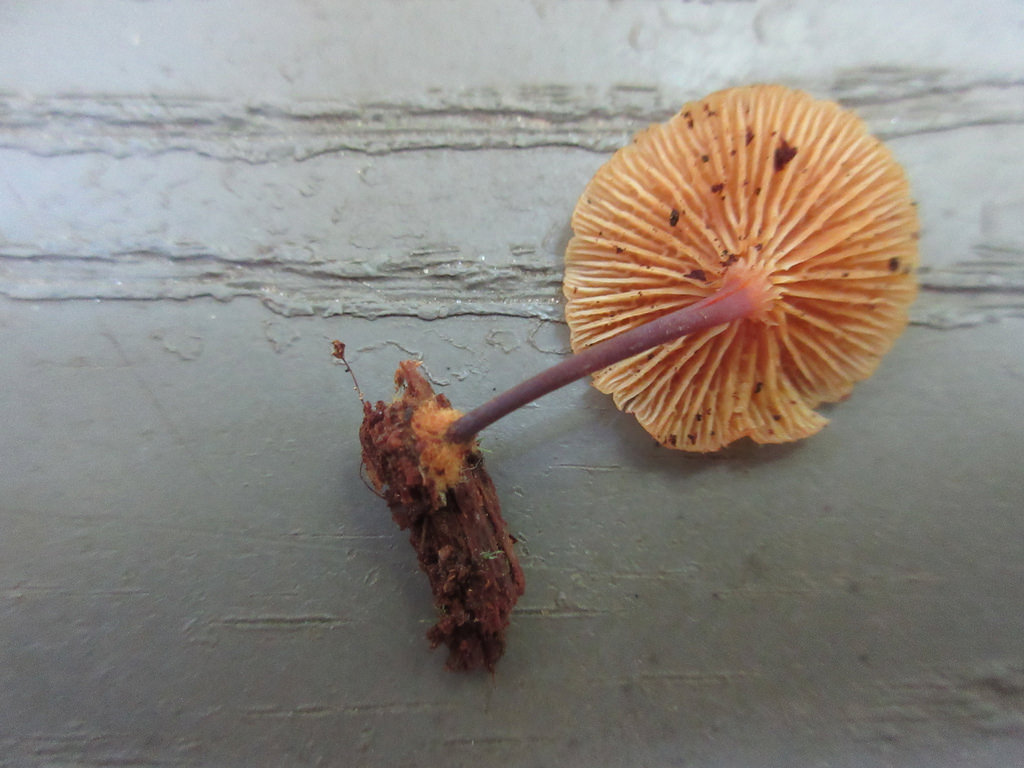
[edit]The fruit body of X. campanella has a small umbrella-shaped cap, about .5–2 centimetres (1⁄4–3⁄4 in) wide.[4] As it matures, the outer part of the cap expands and rises, leaving the center depressed somewhat like a navel.[5] The thin brown stalk is 1–5 cm (1⁄2–2 in) long and 1–3 millimetres (1⁄16–1⁄8 in) wide, yellow at the apex, reddish-brown below, with brown or yellow hairs at the base.[4][6] The gills are pale yellow to pale orange.[4] The flesh is tannish and mild tasting.[7] The spore print is pale buff.[6]
Similar species
[edit]Xeromphalina campanelloides is distinguishable via microscopic features.[8] Xeromphalina kauffmanii resembles the species, but has a more yellow cap[8] and grows on decaying wood of broad-leaved trees.[2] Xeromphalina brunneola also resembles the species, but has smaller, narrowly elliptical spores, and differs in odor, taste, and cap color.[9] Xeromphalina cauticinalis, X. cornui, and X. fulvipes are also similar.[8]
X. enigmatica looks the same but does not interbreed with it.
Habitat and distribution
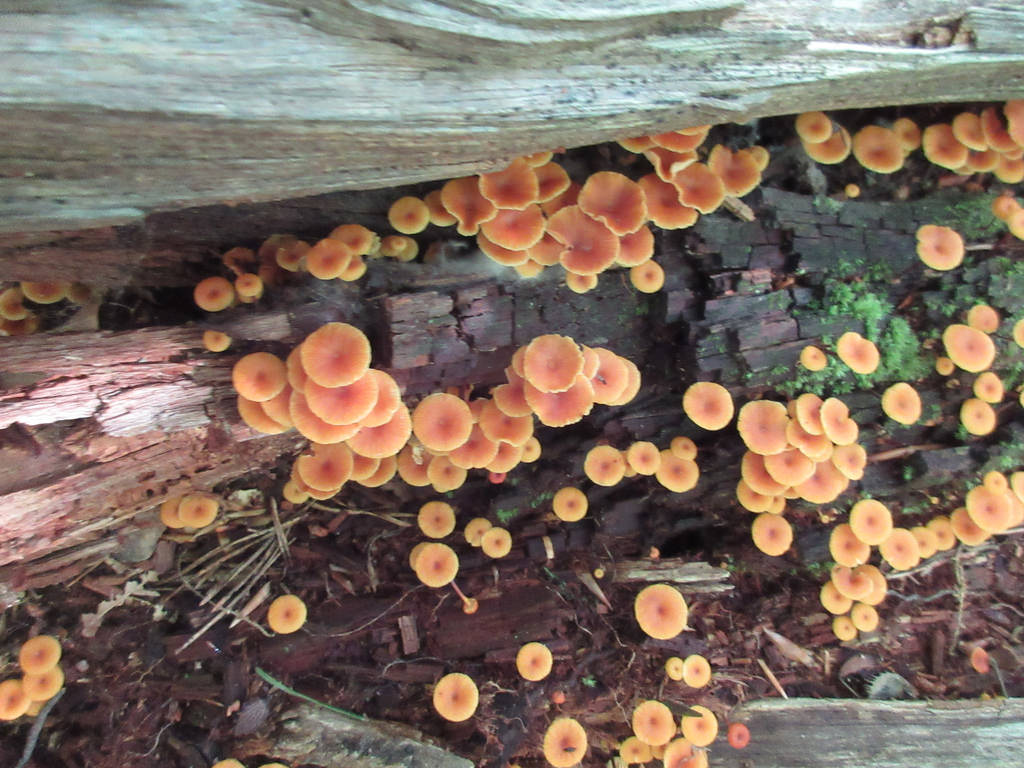
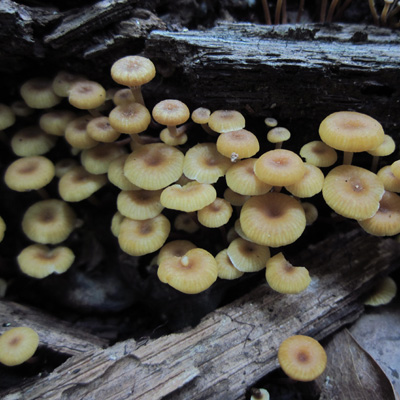
[edit]The fruiting occurs in clumps or very dense clusters on decaying logs, stumps, and woody debris of coniferous trees. The species is commonly found in North America.[6] At times, the species almost entirely covers old tree stumps.[2] The species can be found in any wet season of the year.[5]
It is found in both Eurasia and North America and has some populations that are geographically separated and reproductively isolated.[10]
Edibility
[edit]Although the species is not poisonous,[2] the mushrooms are small and bitter tasting, leading to their often being considered inedible.[5][11][12] In 2006, one author noted that they were privately consumed.[13]
References
[edit]- ^ "Xeromphalina campanella". Mycobank. Retrieved 21 December 2015.
- ^ a b c d C. Roody, William (2003). Mushrooms of West Virginia and the Central Appalachians. University Press of Kentucky. p. 124. ISBN 978-0-8131-9039-6.
- ^ G. Cassidy, Frediric (1991). Dictionary of American Regional English: D - H, Volume 2. Harvard University Press. ISBN 978-0-674-20511-6.
- ^ a b c Davis, R. Michael; Sommer, Robert; Menge, John A. (2012). Field Guide to Mushrooms of Western North America. Berkeley: University of California Press. p. 170. ISBN 978-0-520-95360-4. OCLC 797915861.
- ^ a b c Metzler, Susan and Van (1992). Texas mushrooms: a field guide. University of Texas Press. p. 150. ISBN 978-0-292-75125-5.
- ^ a b c McKnight, Kent H.; McKnight, Vera B. (1998) [1987]. A Field Guide to Mushrooms: North America. Houghton Mifflin Harcourt. pp. 196, 270. ISBN 978-0395910900.
- ^ Audubon (2023). Mushrooms of North America. Knopf. p. 378. ISBN 978-0-593-31998-7.
- ^ a b c Trudell, Steve; Ammirati, Joe (2009). Mushrooms of the Pacific Northwest. Timber Press Field Guides. Portland, OR: Timber Press. pp. 132–133. ISBN 978-0-88192-935-5.
- ^ Bessette, Alan (1995). Mushrooms of North America in color. Syracuse University Press. p. 93. ISBN 978-0-8156-0323-8.
- ^ Aldrovandi, M. S. P.; Johnson, J. E.; OMeara, B.; Petersen, R. H.; Hughes, K. W. (2015-11-01). "The Xeromphalina campanella/kauffmanii complex: species delineation and biogeographical patterns of speciation". Mycologia. 107 (6): 1270–1284. doi:10.3852/15-087. ISSN 0027-5514.
- ^ Miller Jr., Orson K.; Miller, Hope H. (2006). North American Mushrooms: A Field Guide to Edible and Inedible Fungi. Guilford, CN: FalconGuide. p. 193. ISBN 978-0-7627-3109-1.
- ^ Arora, David (1986). Mushrooms Demystified: A Comprehensive Guide to the Fleshy Fungi. Ten Speed Press. p. 634. ISBN 978-0-89815-169-5.
- ^ Russel, Bill (2006). Field guide to wild mushrooms of Pennsylvania and the Mid-Atlantic. Penn State Press. p. 203. ISBN 978-0-271-02891-0.