Map Snapshot


5 Records
Citations
No citations linked for this taxon yet.
Source: Wikipedia
| Polyporus umbellatus | |
|---|---|

| |
Scientific classification 
| |
| Kingdom: | Fungi |
| Division: | Basidiomycota |
| Class: | Agaricomycetes |
| Order: | Polyporales |
| Family: | Polyporaceae |
| Genus: | Polyporus |
| Species: | P. umbellatus
|
| Binomial name | |
| Polyporus umbellatus | |
| Synonyms | |
|
Dendropolyporus umbellatus (Pers.) Jülich | |
| Polyporus umbellatus | |
|---|---|
| Mycological characteristics | |
 | Pores on hymenium |
 | Spore print is white |
 | Ecology is saprotrophic |
 | Edibility is choice |
Polyporus umbellatus is an edible species of mushroom. It is also called umbrella polypore.
Description
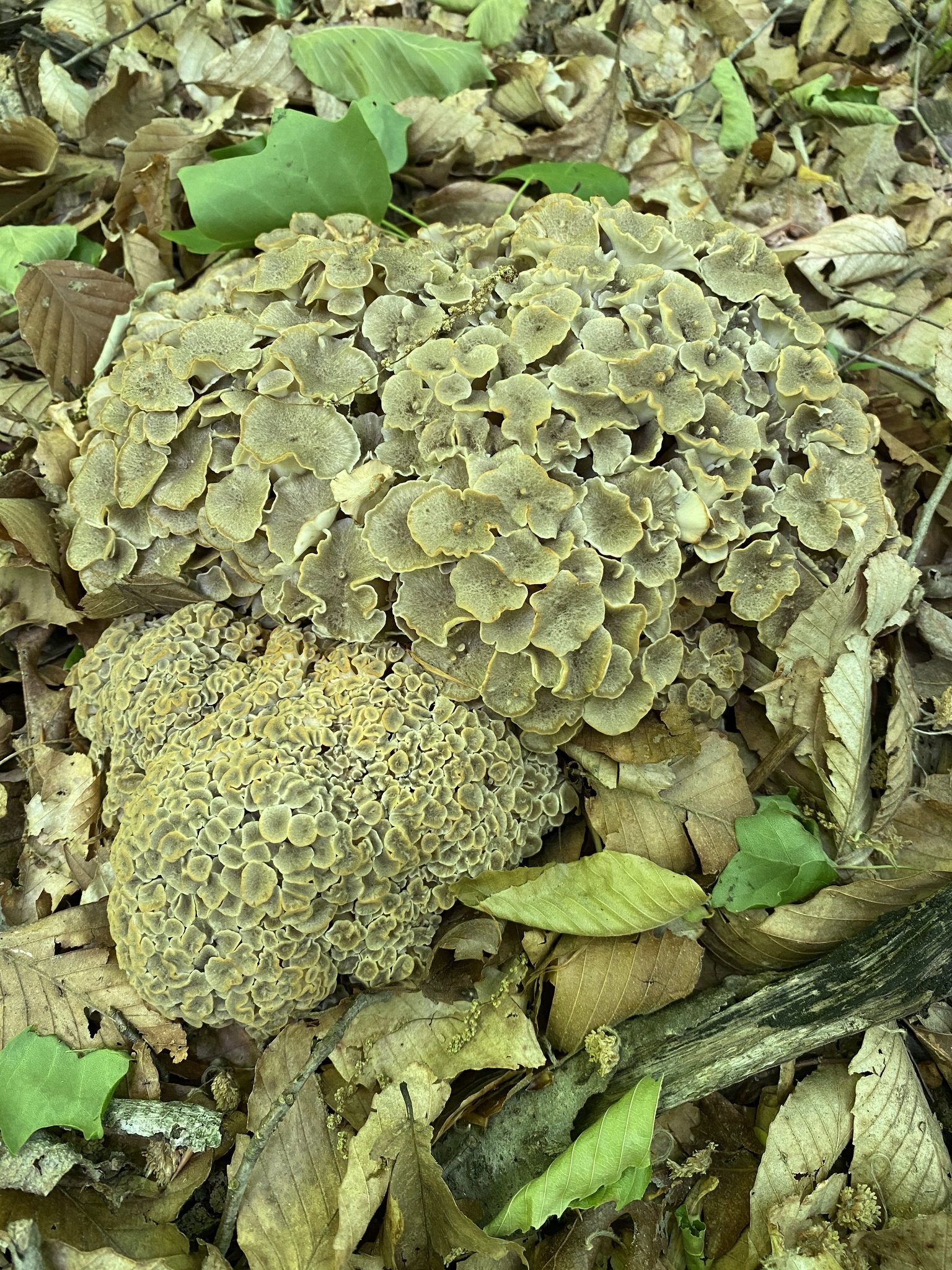
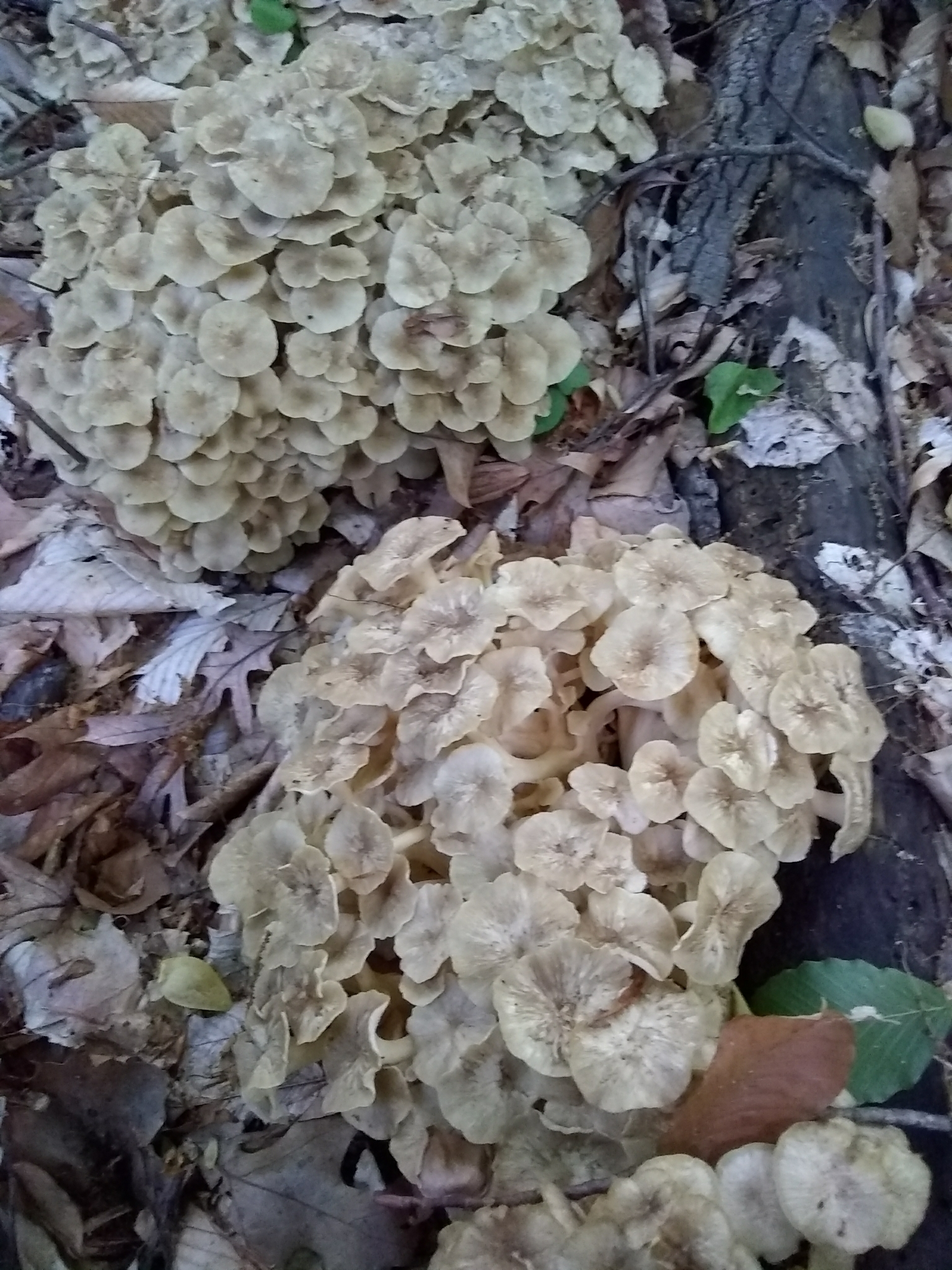
[edit]The fruit body is composed of numerous (sometimes several hundred) caps. They are 1–4 centimetres (1⁄2–1+1⁄2 in) across,[1] deeply umbilicate, light brown, and form the extremities of a strong, many branched stalk. The compound fungus can be up to 40 cm in diameter. The pores are decurrent, narrow and whitish.[1] The stalk is whitish grey, 2.5–7 cm (1–3 in),[1] and originates from a strong, underground, tuber-like nodule. The flesh is white and soft,[1] hardening with age. The spore print is white.[1]
-
 The many branched stalks
 -
 Growing in the wild
 -
 Caps
Caps


Similar species
[edit]The caps of Grifola frondosa are less consistently sized and those of Armillaria tabescens have gills.[1]
Habitat and distribution
[edit]The species grows on roots of old beeches or oak.[2] It can be found in eastern North America from May to September.[1]
Uses
[edit]It is a choice edible mushroom.[3]
Bioactive compounds
[edit]Polyporus umbellatus may contain bioactive compounds with immunostimulating, anticancer, anti-inflammatory, and hepatoprotective properties.[4][5][6][7][8][9][10][11]
The sclerotia stage of the fungal life cycle (a compact mass of hardened fungal mycelium containing food reserves) is the one used in Chinese medicine, and a 79.74 Mb reference genome was sequenced to better understand its formation.[12]
References
[edit]- ^ a b c d e f g Audubon (2023). Mushrooms of North America. Knopf. p. 282. ISBN 978-0-593-31998-7.
- ^ Kunca V., 2011: Ecology and incidence of Polyporus umbellatus in Slovakia. Czech Mycology 63(1): 39–53. [1]
- ^ "Polyporus umbellatus". Midwest American Mycological Information. 2019-06-25. Retrieved 2022-11-09.
- ^ Li X, Xu W, Chen J (2010). "Polysaccharide purified from Polyporus umbellatus (Per) Fr induces the activation and maturation of murine bone-derived dendritic cells via toll-like receptor 4". Cell Immunol. 265 (1): 50–6. doi:10.1016/j.cellimm.2010.07.002. PMID 20673883.
- ^ Zhao YY, Chao X, Zhang Y, Lin RC, Sun WJ (2010). "Cytotoxic Steroids from Polyporus umbellatus". Planta Med. 76 (15): 1755–8. Bibcode:2010PlMed..76.1755Z. doi:10.1055/s-0030-1249926. PMID 20458671.
- ^ Sun Y, Yasukawa K (2008). "New anti-inflammatory ergostane-type ecdysteroids from the sclerotium of Polyporus umbellatus". Bioorg Med Chem Lett. 18 (11): 3417–20. doi:10.1016/j.bmcl.2008.04.008. PMID 18439824.
- ^ Zhou WW, Lin WH, Guo SX (2007). "Two new polyporusterones isolated from the sclerotia of Polyporus umbellatus". Chem Pharm Bull. 55 (8): 1148–50. doi:10.1248/cpb.55.1148. PMID 17666835.
- ^ You JS, Hau DM, Chen KT, Huang HF (1994). "Combined effects of chuling (Polyporus umbellatus) extract and mitomycin C on experimental liver cancer". Am J Chin Med. 22 (1): 19–28. doi:10.1142/S0192415X94000048. PMID 8030616.
- ^ Ohsawa T, Yukawa M, Takao C, Murayama M, Bando H (1992). "Studies on constituents of fruit body of Polyporus umbellatus and their cytotoxic activity". Chem Pharm Bull. 40 (1): 143–7. doi:10.1248/cpb.40.143. PMID 1576664.
- ^ Zhang YH, Liu YL, Yan SC (1991). "[Effect of Polyporus umbellatus polysaccharide on function of macrophages in the peritoneal cavities of mice with liver lesions]". Zhong Xi Yi Jie He Za Zhi. 11 (4): 225–6, 198. PMID 1773459.
- ^ Lin YF, Wu GL (1988). "[Protective effect of Polyporus umbellatus polysaccharide on toxic hepatitis in mice]". Zhongguo Yao Li Xue Bao. 9 (4): 345–8. PMID 3195347.
- ^ Chi, Li; Liu, Tianrui; Hua, Zhongyi; Han, Pengjie; Jiao, Honghong; Yuan, Yuan (2025-03-17). "Genome sequencing highlights the fungal sclerotium formation of medicinal fungi Polyporus umbellatus". BMC Genomic Data. 26 (1): 17. doi:10.1186/s12863-025-01311-8. ISSN 2730-6844. PMC 11912782. PMID 40091026.
 | This Polyporales-related article is a stub. You can help Wikipedia by adding missing information. |