
Map Snapshot


19 Records
Citations
No citations linked for this taxon yet.
Source: Wikipedia
| Veronica americana | |
|---|---|

| |
Scientific classification 
| |
| Kingdom: | Plantae |
| Clade: | Tracheophytes |
| Clade: | Angiosperms |
| Clade: | Eudicots |
| Clade: | Asterids |
| Order: | Lamiales |
| Family: | Plantaginaceae |
| Genus: | Veronica |
| Species: | V. americana
|
| Binomial name | |
| Veronica americana | |
| Synonyms[3] | |
| |


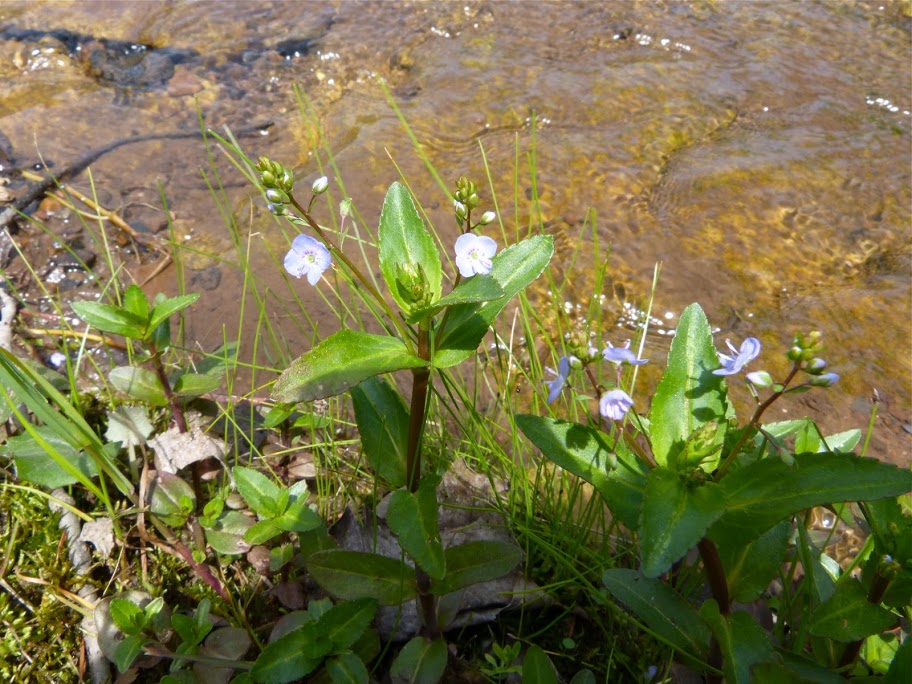
Veronica americana, variously called American brooklime[4] or American speedwell,[4][5] is a flowering plant native to temperate and arctic Asia and North America[4] where it grows in streams and bottomlands.
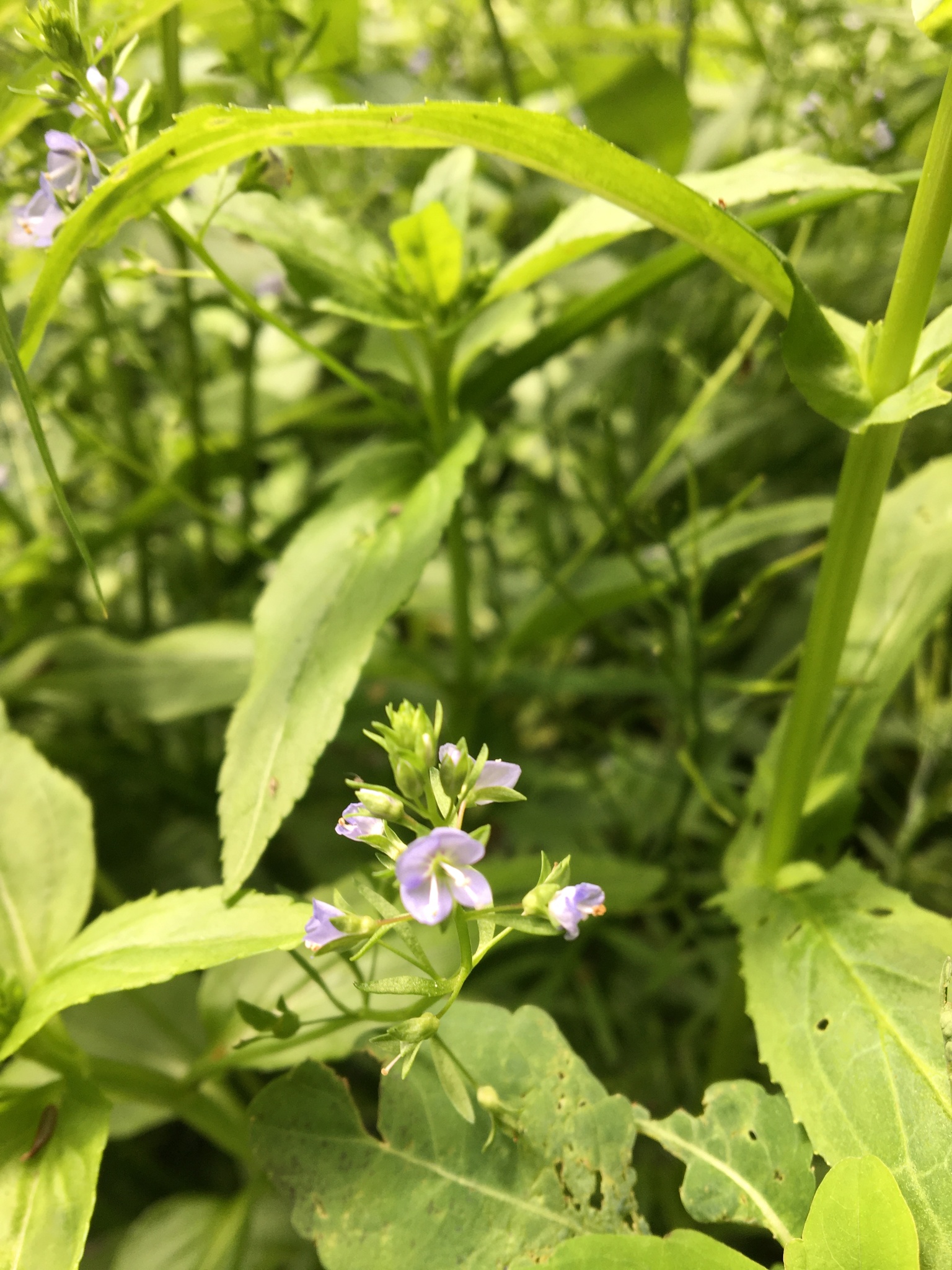
It is a herbaceous perennial with glabrous stems 10–100 cm (4–40 in) long that bear terminal or axillary racemes or spikes of soft violet flowers. The leaves are 1.5–8 cm (0.6–3.1 in) long and 3 to 20 times as long as wide, short-petiolate, glabrous, serrate to almost entire.[6]
The plant can be confused with Scutellaria (skullcap) and other members of the mint family. Members of the mint family have square sided stems, and Veronica species have rounded stems.[7]
Taxonomy
[edit]In 1830 Constantine Samuel Rafinesque described a variety of Veronica beccabunga he named americana. The botanist George Bentham raised to species status in a publication published in 1846 where he credited Lewis David de Schweinitz, giving the taxa its accepted name. It is classified in the genus Veronica which is part of the Plantaginaceae family. It does not have any accepted varieties or forms, but there are three among its eight synonyms.[3]
| Name | Year | Rank | Notes |
|---|---|---|---|
| Veronica americana f. albiflora Tatew. ex H.Hara | 1948 | form | = het. |
| Veronica americana var. crassula Rydb. | 1900 | variety | = het. |
| Veronica americana f. rosea J.K.Henry | 1917 | form | = het. |
| Veronica anagallis Bong. | 1832 | species | = het. |
| Veronica beccabunga var. americana Torr. | 1843 | variety | = het., nom. illeg. |
| Veronica beccabunga var. americana Raf. | 1830 | variety | ≡ hom. |
| Veronica crenatifolia Greene | 1903 | species | = het. |
| Veronica intermedia Schwein. | 1824 | species | = het., nom. illeg. |
| Notes: ≡ homotypic synonym ; = heterotypic synonym | |||
Uses
[edit]American speedwell is used both as food and as a medicinal plant.[citation needed] It is rich in nutrients and is reported to have a flavor similar to that of watercress.[8] As long as the water source is not contaminated, the entire plant (sans roots) can be eaten raw.[9]
References
[edit]- ^ Maiz-Tome, L. (2016). "Veronica americana". IUCN Red List of Threatened Species. 2016 e.T64326255A67731217. Retrieved 8 February 2024.
- ^ NatureServe (3 April 2026). "Veronica americana". NatureServe Explorer. Arlington, Virginia. Retrieved 11 April 2026.
- ^ a b POWO (2026). "Veronica americana (Raf.) Schwein. ex Benth". Plants of the World Online. Royal Botanic Gardens, Kew. Retrieved 11 April 2026.
- ^ a b c "Veronica americana". Germplasm Resources Information Network. Agricultural Research Service, United States Department of Agriculture. Retrieved 2008-03-30.
- ^ "Veronica americana Schwein. ex Benth". PLANTS Profile. United States Department of Agriculture; Natural Resources Conservation Service. Retrieved 2008-03-30.
- ^ "Veronica americana". WTU Herbarium Image Collection. Burke Museum, University of Washington. Retrieved 2008-03-30.
- ^ Edible and Medicinal Plants of the West, Gregory L. Tilford, ISBN 0-87842-359-1
- ^ Reiner, Ralph E. (1969). Introducing the Flowering Beauty of Glacier National Park and the Majestic High Rockies. Glacier Park, Inc. p. 96.
- ^ Nyerges, Christopher (2017). Foraging Washington: Finding, Identifying, and Preparing Edible Wild Foods. Guilford, CT: Falcon Guides. ISBN 978-1-4930-2534-3. OCLC 965922681.
Further reading
[edit]
- Moreno-Escobar, Jorge; Alvarez, Laura; Rodriguez-Lopez, Veronica; Marquina Bahena, Silvia (2013). "Cytotoxic glucosydic iridoids from Veronica americana". Phytochemistry Letters. 6 (4): 610–613. Bibcode:2013PChL....6..610M. doi:10.1016/j.phytol.2013.07.017.
 | This Plantaginaceae article is a stub. You can help Wikipedia by adding missing information. |