

Map Snapshot

1 Record
Citations
No citations linked for this taxon yet.
Source: Wikipedia
| Triepeolus donatus | |
|---|---|
.jpg)
| |
| Triepeolus donatus | |
.jpg)
| |
| Triepeolus donatus | |
Scientific classification 
| |
| Kingdom: | Animalia |
| Phylum: | Arthropoda |
| Clade: | Pancrustacea |
| Class: | Insecta |
| Order: | Hymenoptera |
| Family: | Apidae |
| Genus: | Triepeolus |
| Species: | T. donatus
|
| Binomial name | |
| Triepeolus donatus (Smith, 1854)
| |
| Synonyms | |
| |
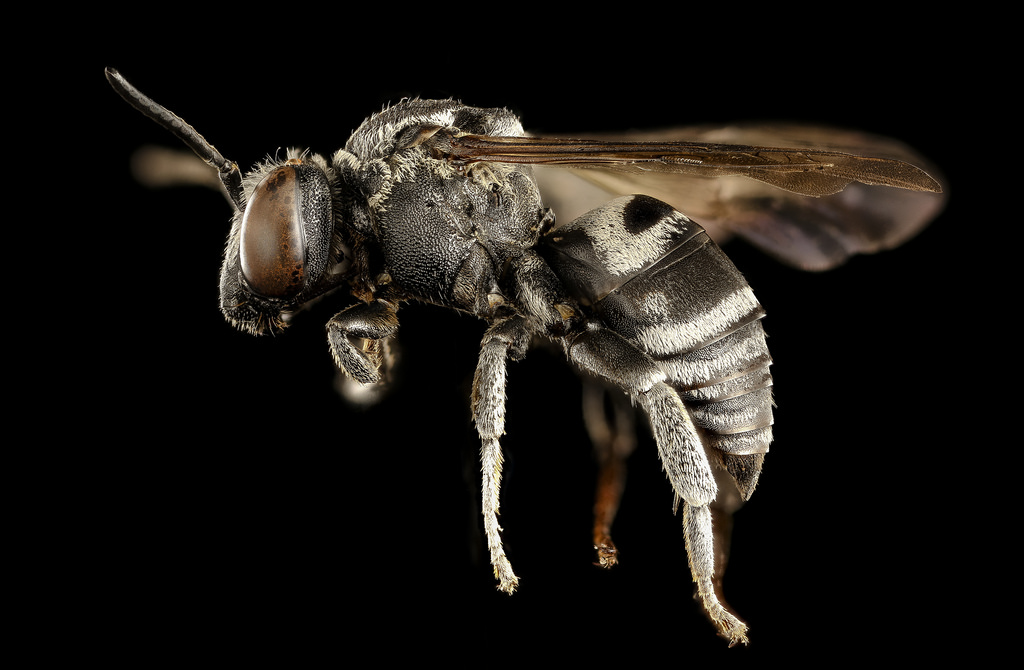
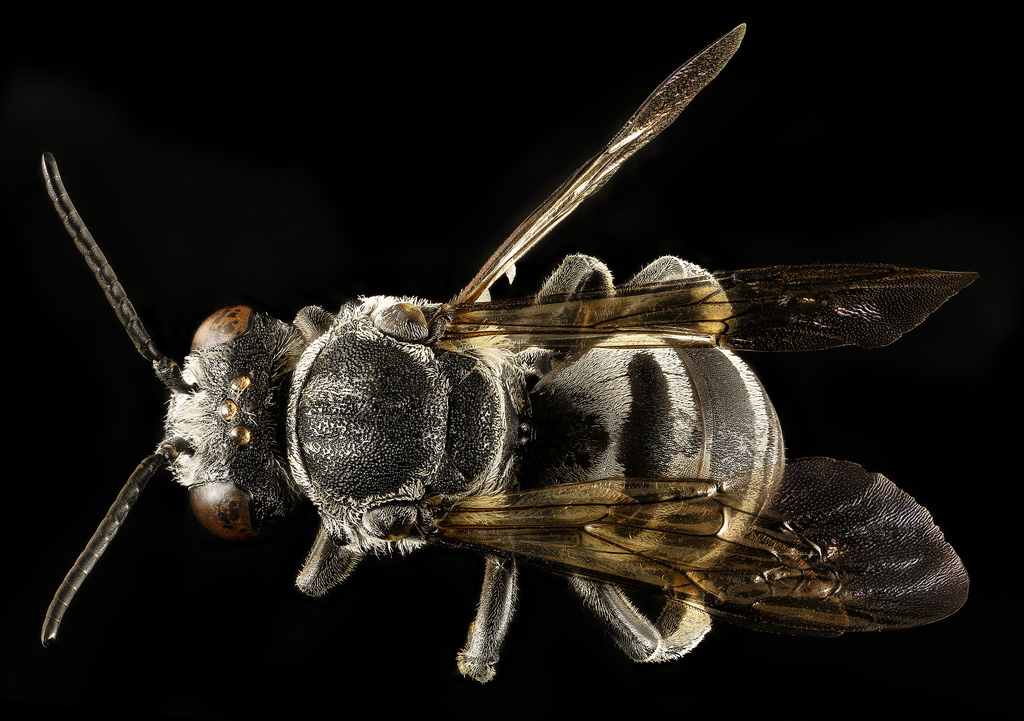
Triepeolus donatus is a species of cuckoo bee in the family Apidae.[1][2] It is found in North America, specifically in the United states and Canada.[1] They are characterized by a overall black body with white strips.[3]
Description
[edit].jpg)
The head of T. donatus is black and covered in short gray-white hair that is denser in regions around the antennae base in females. The lower mandibles have a reddish color. The antennae are black and females have longer segments than males. The thorax is black with grayish-white borders and a white color strip. The thorax also has many strips along it. The abdomen are black with gray-white strips on it.[3]
The legs are brown to black on color and covered in silvery-white hairs. Populations of Triepeolus donatus in Iowa, Minnesota and North Dakota have legs that are more red in color. The wings are black on females and reddish on males. The veins of the wings are always black.[3]
Distribution
[edit]This species on located in North America, specifically in the eastern United States (Idaho, Indiana, Iowa, Minnesota, North Dakota, South Carolina, Pennsylvania, Vermont, etc) and Canada, specifically Ontario.[3] They live in suburban and urban forest.[4]
References
[edit]- ^ a b "Triepeolus donatus Report". Integrated Taxonomic Information System. Retrieved 8 February 2018.
- ^ "Triepeolus donatus Overview". Encyclopedia of Life. Retrieved 8 February 2018.
- ^ a b c d "Triepeolus donatus Species Information". BugGuide.net. Retrieved 8 February 2018.
- ^ "NatureServe Explorer 2.0". explorer.natureserve.org. Retrieved 4 June 2025.
Further reading
[edit]- Arnett, Ross H. (30 July 2000). American Insects: A Handbook of the Insects of America North of Mexico. CRC Press. ISBN 978-0-8493-0212-1.
- Sharkey, M.J. (2007). "Phylogeny and Classification of Hymenoptera". Zootaxa. 309: 13–48.
- Sharkey, M.J.; Carpenter, J.M.; Vilhelmsen, L. (2012). "Phylogenetic relationships among superfamilies of Hymenoptera". Cladistics. 28 (1): 80–112.
