Map Snapshot


44 Records
Status
Description
Citations
No citations linked for this taxon yet.
Source: Wikipedia
| Euthamia caroliniana | |
|---|---|

| |
Scientific classification 
| |
| Kingdom: | Plantae |
| Clade: | Tracheophytes |
| Clade: | Angiosperms |
| Clade: | Eudicots |
| Clade: | Asterids |
| Order: | Asterales |
| Family: | Asteraceae |
| Genus: | Euthamia |
| Species: | E. caroliniana
|
| Binomial name | |
| Euthamia caroliniana (L.) Greene ex Porter & Britton[1]
| |
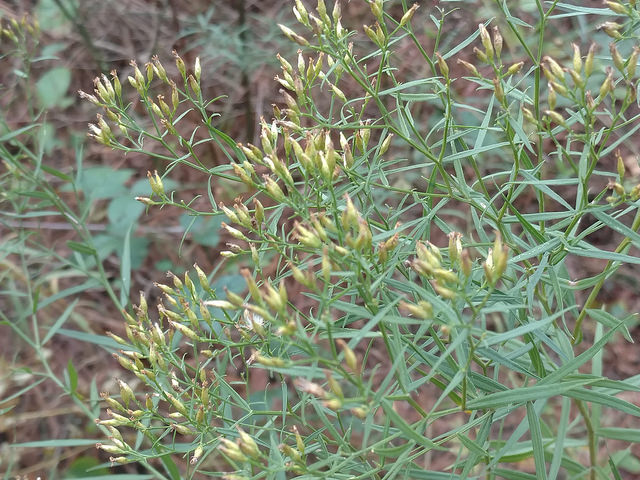
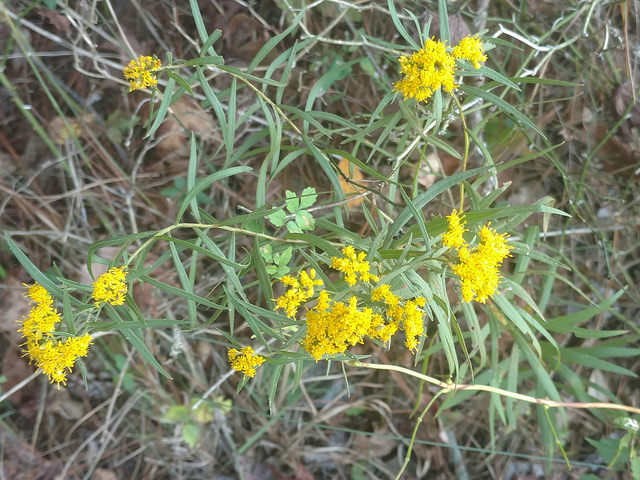
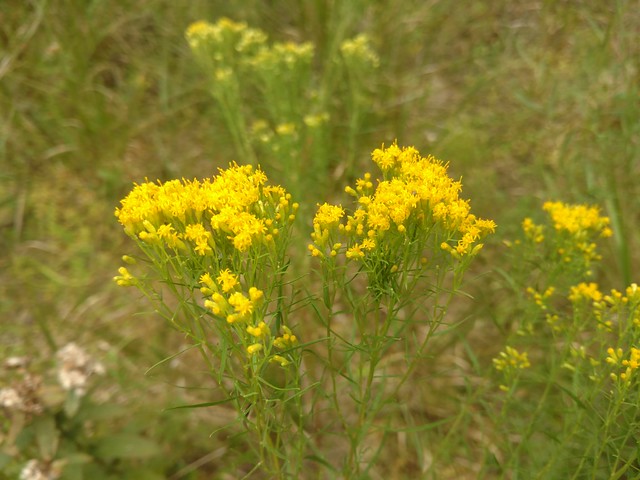
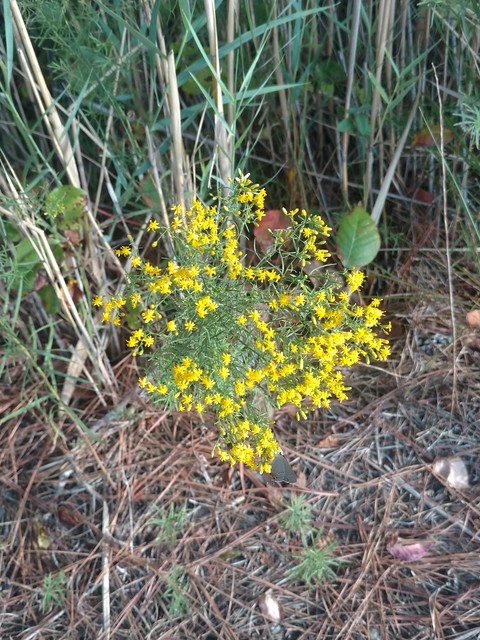
Euthamia caroliniana, known as Carolina grass-leaved goldenrod[2] or slender goldentop[3] is a flowering plant in the genus Euthamia, a member of the family Asteraceae. It is listed as Vulnerable due to habitat loss and disturbance within its range.[4]
Distribution
[edit]Euthamia caroliniana is found primarily on the Atlantic Coastal Plain between Nova Scotia and eastern Texas.[5] It also has populations in the Great Lakes region and around Lake Champlain.[5] Inland populations are also known from Indiana to Kentucky.[5] Within its range, it can be found in open sandy areas, such as powerline cuts in pine barrens.
Identification
[edit]Carolina goldentop grows up to 1 meter (3 ft 3 in) in height from a branched, creeping rhizome.[6]
Along the east coast, the only similar-looking species is grass-leaved goldentop, which has wider leaves with one to three conspicuous veins (versus narrow leaves with only one vein in Carolina goldentops).
Its range also overlaps with Great Plains goldentop in the western Great Lakes and along Gulf Coast and bushy goldentop along the Gulf Coast.
Galls
[edit]This species is host to the following insect induced galls:
- Asteromyia euthamiae Gagné, 1968 This midge forms black spots on leaf blades
- Rhopalomyia fusiformae Felt, 1907 Small galls by a fly larvae on leaves, stems and flowers.
Ecology
[edit]E. caroliniana grows in a range of habitats such as moist forests, pastures, roadsides, ditches, and other disturbed areas[7]
It forms a persistent soil seed bank,[8] which can persist through fire disturbance.[9]
References
[edit]- ^ "Euthamia caroliniana". ipni.org. International Plant Names Index. Retrieved 2018-09-09.
- ^ Mohlenbrock, Robert H. (2015). Flowering plants. Asteraceae. Part 1. Southern Illinois University Press. ISBN 9780809333677.
- ^ Reznicek, A. A.; Voss, E. G.; Walters, B. S., eds. (February 2011). "Euthamia caroliniana". Michigan Flora Online. University of Michigan Herbarium. Retrieved 2018-09-09.
- ^ "NatureServe Explorer 2.0". explorer.natureserve.org.
- ^ a b c "2013 BONAP North American Plant Atlas. TaxonMaps". bonap.net.
- ^ [1] NatureServe Explorer. Accessed: May 13, 2019
- ^ Weakley, A.S. 2020. Flora of the Southeastern United States. Edition of 20 October 2020. University of North Carolina at Chapel Hill, Chapel Hill, North Carolina.
- ^ Navarra, J. J., N. Kohfeldt, et al. (2011). "Seed bank changes with time since fire in Florida rosemary scrub." Fire Ecology 7(2).
- ^ Kalmbacher, R., et al. (2005). "Seeds obtained by vacuuming the soil surface after fire compared with soil seedbank in a flatwoods plant community." Native Plants Journal 6: 233-241.
 | This Astereae article is a stub. You can help Wikipedia by adding missing information. |