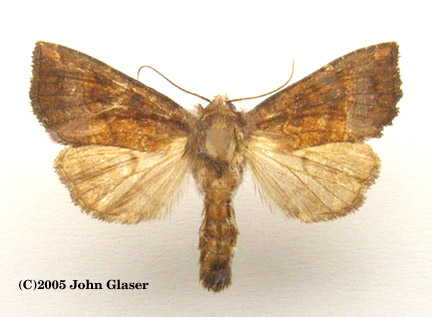
A Meadow Rue Borer Moth collected in Washington Co., Maryland (7/20/1993).
Map Snapshot


8 Records
Relationships
Preferred larval host is Thalictrum sp. Larvae bore into roots. (Quinter E.L., McBride A.E. (2025) The Moths of North America.)
Citations
No citations linked for this taxon yet.
Use of media featured on Maryland
Biodiversity Project is only permitted with express permission of the
photographer.
A Meadow Rue Borer Moth collected in Washington Co., Maryland (7/20/1993).
View Record Details
Media by
John Glaser.
Source: Wikipedia
| Meadow Rue Borer | |
|---|---|
Scientific classification 
| |
| Kingdom: | Animalia |
| Phylum: | Arthropoda |
| Clade: | Pancrustacea |
| Class: | Insecta |
| Order: | Lepidoptera |
| Superfamily: | Noctuoidea |
| Family: | Noctuidae |
| Genus: | Papaipema |
| Species: | P. unimoda
|
| Binomial name | |
| Papaipema unimoda | |
| Synonyms | |
| |
The meadow rue borer (Papaipema unimoda) is a species of moth of the family Noctuidae. It is found in the north-eastern United States and southern Canada east of the Rocky Mountains.[3]
The wingspan is 30–40 mm. Adults are on wing from August to October in one generation per year.
The larvae feed on Thalictrum, Rudbeckia, Smilax, and Polemonium species. They bore in the roots and stems of their host plant.
References
[edit]- ^ Papaipema at funet
- ^ mothphotographersgroup
- ^ Papaipema unimoda, Bug Guide